



Introduction
Christianity is in crisis. The religion that once defined the continent of Europe now struggles to withstand the demands of the modern age.
The Bible – supposedly, the Word of God – holds little value in practice. The sacraments – baptism, eucharist, and a whole multitude of others – are merely rituals of history, rather than aspects of a living faith.
For instance, over recent years, the Church of England have reportedly been considering using gender-neutral terms to refer to God.[1] Indeed, a section of the clergy have already been using the feminine form in their services for some time.[2] It remains unclear what will replace terms such as ‘Our Father’, but suggestions by the clergy have been forthcoming.
In a society where personal pronouns are deemed paramount, it never seemed to have occurred to anyone – not least the clergy – that perhaps God would have a say in His own personal matter!
Aside from the comical nature of this episode, the situation underscores an unsettling development within Christendom, dare I say, within Christian leadership: God is no longer held sovereign.
Naturally, this is not an isolated incident. It forms part of a continuum that has been ongoing for decades: theological adaptation in accordance with the ever-changing demands of society.
In this article we will address what many have termed as the self-secularisation process unfolding within the four walls of Christendom. Furthermore, we will address briefly how Islam has mostly resisted this process, and how, unlike Christianity, it has the key ingredients necessary to withstand the negative influences of the modern age.

A stunning church in Budapest
Christianity’s Path to Self-Secularisation
In his essay, Causes of the decline: Historical, empirical, and theoretical perspectives, the historian Paul Silas Peterson highlights ten broad categories that are said to have contributed to the decline of Christianity in the Western world. Among them are “socio-political and cultural transformations” such as Enlightenment and the Industrial Revolution; the “good economy and prosperity”; and the “emergence of the modern 20th-century welfare state.” These factors are well understood in the wider public and have much to say about Christianity. What is less well-known, perhaps, is what some have termed as the “self-secularization” of Christianity unfolding before our eyes. Describing it as distinct category in its own right, Peterson writes:
“The abandonment of specific long-held traditional doctrinal positions (that is, more precisely, the failure to teach them and defend them as credible) and the adoption of new paradigms of world-interpretation and new paradigms of the interpretation of human existence (which are not dependent upon the faith per se) have essentially made the Christian faith irrelevant.” [3]
The secularisation process has its beginning in the Enlightenment period, with many of the enlightenment founders such as Hegel, Kant, and the German theologian Friedrich Schleiermacher. Many Enlightenment thinkers, and those who followed them, might have believed such reformations to ultimately be of benefit for the Christian faith, and the society as a whole.
Today, many theologians who have inherited those reformed expressions of the faith – and others who continue to reform their teachings – may do so to keep the last vestiges of the Church alive. They may do so in an effort to attract new members – or, at least, to retain its existing membership; or, to put it another way, to appeal to the socio-cultural necessities of the times. Yet, it appears to be a losing game.
People are leaving churches in droves across all major groups in the West. And church attendance is steadily in decline. In Britain, for instance, Christianity is now a minority religion. And, although Islam is a much smaller religion in Britain, more Brits attend a mosque than they attend a church.
In this section we highlight some of the steps taken by Christian churches in the West that have contributed to their secularisation. In later sections we address why they have taken such steps – focusing our attention, in particular, to theology.
Secularisation of Scripture
Peterson’s broad assessment of the secularisation process is correct. The failure to teach long-held traditional beliefs and defend them as credible is endemic among Christian seminaries and schools.
For instance, in a survey conducted by an American parachurch organisation, Answers in Genesis, children as young as those in elementary school begin to have reservations about many of the biblical claims[4] – in particular, the creation story of Genesis. What is more surprising, however, is that Church-led Sunday schools have no positive impact in drawing the young to their faith. In fact, the effect is slightly negative.[5] Drawing on his years of experience, Sunday school curricula, Bible study groups, and children’s literature, Ken Ham, the face of the organisation writes:
“Often those kids who attend Sunday school will ask their Sunday school teachers… about millions of years, or dinosaurs and associated topics, wanting an answer from an authority figure who represents, in their eyes, Christianity and the Bible. And what do they hear? Sadly, in the majority of instances, the Sunday school teachers will tell them that that is not a topic for Sunday school/church – and/or they can believe in millions of years and evolution as long as they trust in Jesus. The most important thing as far as the teacher is concerned is that the students trust in Jesus – those questions the students asked about origins issues aren’t that important. It doesn’t matter what one believes about Genesis.” [6]
In another survey conducted in the United States among those who had left religion for atheism, agnosticism, or nothing in particular, almost half of them did so over a ‘lack of belief’. The main justifications centred on science, logic, and a lack of evidence.[7]
Consequently, we find that many Christian theologians have given in, and have accepted many of the scientific claims, contrary to what Ken Ham believes are biblical claims in Genesis. And they have all done so on the faulty assumption that a belief in crucifixion and resurrection suffices. Ken Ham laments:
“Highly respected church leaders and theologians have given in. Many well-known Christian scholars, professors, evangelists, and the like have compromised the Bible with an old (millions-of-years) earth.”[8]
Ken Ham appears to have Protestant leaders in mind. But his assessment is applicable further afield. For instance, within the Catholic Church, Pope Francis previously made official remarks stating that evolution is compatible with the creation story of Genesis.[9] Indeed, according to one assessment by a prominent Catholic physicist, the Church “has never had a quarrel with the idea of evolution or with the Darwinian theory of natural selection acting on random genetic mutations.”[10]

In the United States, the story is quite different. While many Protestant leaders are young-Earth creationists, others have embraced a European-style interpretation of the creation story of Genesis. There are many who accept the dominant scientific paradigm, while others, such as a section of the Southern Baptist Convention – the largest Protestant denominations in the country – have spoken favourably of the Intelligent Design movement – a movement which generally accepts the evolution of species over millions of years.[11]
According to Ken Ham, the theory of evolution is primarily responsible for the decline of religiosity in England. And, according to him, United States appears to be following its lead – with many losing their faith over similar reasons.[12]
Unfortunately, the secularisation of scripture is but one facet of the self-secularisation process unfolding before our eyes. In the next subsection, we take a brief look at the institutions at the heart of Christian life – the Churches.
Secularisation of the Church
Over the last decade, the number of total Churches in the UK fell by two thousand.[13] In the US – a country known for its religious conservatism in the West – closures of Protestant Churches outpaced openings of new ones in 2019 for the first time.[14] Furthermore, Church attendance is steadily in decline across Europe and the United States.
The sustained decline has kindled a sense of desperation among many Church leaders and theologians. There is much evidence to support the idea that many are seeking novel techniques to reverse this trend. Recommendations range from emphasis on cultural relevance, innovation of new services within the church, and adoption of new forms of music. Despite their endeavours, none of these techniques appear to make a notable difference.
Unfortunately, the decline continues, undisturbed. Ken Ham, on observing this trend, described this course of action as a placebo – a superficial solution for a much deeper problem:
“In our efforts to slow the flood of young adults who are leaving, we often give the Church a placebo. We try to restore cultural relevancy without restoring biblical relevancy… Becoming ‘culturally cool’ can feel like it helps for a while, but it’s really just a placebo, a Band-Aid for a much deeper disease.”[15]
In an age of materialism, one might think that such techniques might draw new members, or at least retain existing membership. However, studies indicate otherwise. For instance, concerning efforts to make the church more dynamic through vibrant music, Ken Ham writes:
“I have visited hundreds and hundreds of churches. Everywhere I go, music seems to be the central issue… We think that if we can make it dynamic, energetic, and fit the style of the generation we’re trying to reach, the epidemic will be stopped, and young people will start flooding back into the Church. That’s simply not the case. Our research showed that music is not a fundamental factor in young adults choosing to leave or stay at a church.”[16]
While traditional to Christianity, employment of music in church services has grown astronomically over the last century. Pentecostalism is a case in point. Pentecostal congregations place a strong emphasis on emotionally charged services – attracting a vibrant atmosphere. And today, they are said to be among the fastest growing Christian denomination. Their growth, however, is mostly attributed to conversions from other Christian denominations. As a result, they have done little to slow the overall trend of people leaving the Christian faith.
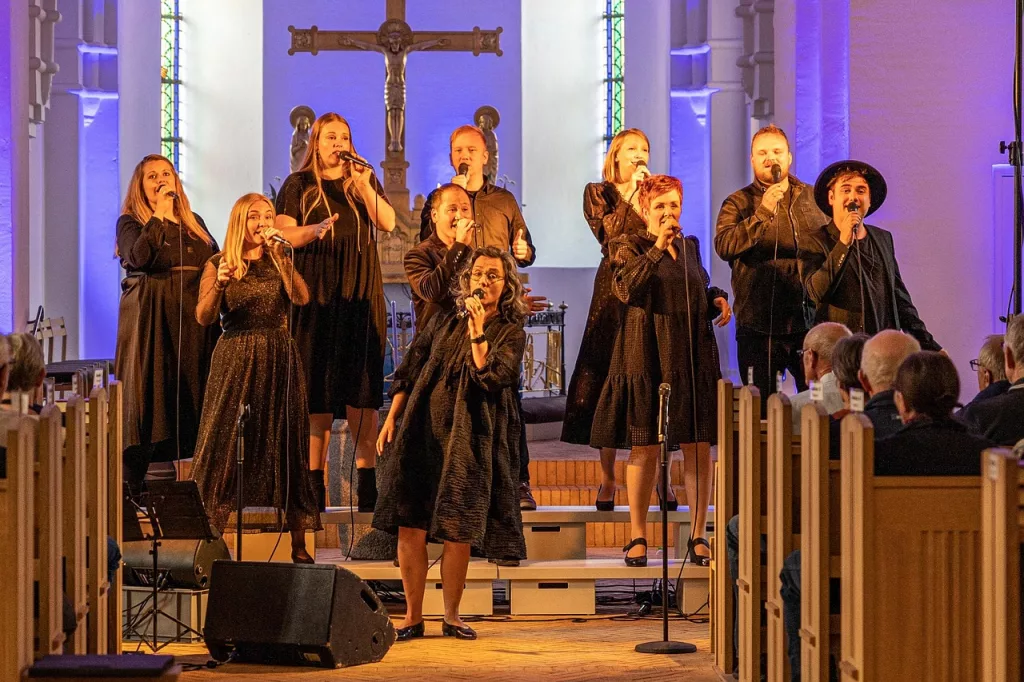
Music and other means of entertainment does have the ability to lure in a crowd. But it cannot stop the flood of apostasies from Christianity – especially from the younger generations. Despite the measures, the elderly continue to dominate Church congregations – a demographic that will soon pass away, leaving no offspring to continue in their footsteps. And while such measures may draw in people in their formative years while young and impressionable, it will not do so as they mature, become independent, and venture into the world. Indeed, such means of entertainment are already widely available to the public – and, in fact, to a greater degree – in concert halls, pubs, and recreational centres.
Another study, conducted by a different evangelical group – the Willow Creek association – goes further. Referring to it as a “stunning discovery”, they found that “higher levels of [church] activity do not seem to drive spiritual growth, when defined as ‘increasing love for God and others.’”[17]
This discovery, while surprising, is easily explained. If the primary reason for attending a church is simply social entertainment, then genuine spirituality and love for God could not possibly blossom. As one keen Christian observer noted:
“When you go to a birthday party, you don’t go because there will be drums and guitars accompanying the song “Happy Birthday.”… You go because you admire and love the person celebrating the date of their birth and because of that admiration, you sing “Happy Birthday.”… The music is not the reason why people go to these types of celebrations, but it is an important part because they have something to sing about. People shouldn’t be going to church because of the music or any other gimmick, they should go for another reason.”[18]
The church leadership has clearly erred in their effort to attract congregations to the church. The final topic we shall briefly examine pertains to the secularisation of the moral ethics which, unlike the previous two, cuts through politics.
Secularisation of the Moral Law
In the survey cited earlier, while almost one-half had left religion in the United States over a lack of belief, one-fifth had done so over a dislike of organised religion. In this case, the main justifications centred on the role of organised religion as a source of division, a source of harm, and a source of unethical moral teachings.[19]
In the introduction we had cited an amusing development within the Church of England. To a casual observer, this might appear to be an isolated incident. But it is not.
While the Bible severely condemns homosexual acts as sin,[20] going as far as prescribing the death penalty at some point in its history,[21] the Church of England, in a complete U-turn, voted to bless same-sex unions. While divorce, and marriage after divorce, has been likened to adultery in the Gospels,[22] the Church has increasingly become accustomed to it – approving divorce, and marriage after divorce in 2002.[23] While Jesus – through his practical example – had only ordained men as his apostles to preach his message, and while Paul had prohibited women from holding positions of religious authority,[24] the Church has withdrawn itself completely from its spiritual forebearers – ordaining women to priesthood since 1994.[25]
Similarly, there are many churches in the United States who have adopted a more liberal view, wholly disconnected from the plain dictates of the Bible.
The Catholic Church, on the other hand, has mostly resisted tendencies plaguing some of the largest Protestant Churches in the western world. However, it is also showing signs of capitulation. There are calls among leading Cardinals to reshape its teachings on homosexuality,[26] divorce,[27] and a number of other social issues impacting the West.
Put simply, the Christian leadership has been in a downward spiral for decades, if not centuries – dislodging its moral laws one by one. It knows no bounds. And for all we know, it will continue to do so until there remains no discernible difference between their teachings and secular laws.
With this, we end our brief examination. In the next section we delve into the meat of the matter. Why are Christian theologians willing to forgo their long-held teachings?
Why Did Christian Leadership Secularise?
As mentioned earlier, in his essay, Causes of the decline: Historical, empirical, and theoretical perspectives, Peterson introduces many possible explanations for the decline of Christianity in the West. Among them is what many have termed as the “self-secularization” process unfolding within the four walls of Christianity.
One may ask, why did Christian theologians, over hundreds of years, resolved to secularise their faith? And why do they continue to do so? Peterson gives one explanation:
“The self-secularization of the faith happened because of the desire to stay at the forefront of cultural, social, and intellectual trends. Churches abandoned long-held traditional beliefs and practices in order to reduce the degree of difference between the churches and secularizing society at large…It was presumed that the faith could survive in a new form of expression even though specific features of the traditional religion had been abandoned (traditional teachings about God, scripture as divine revelation, narratives of creation, Christology, eschatology, etc.).”[28]
This addresses some of the external factors that led Churches to secularise their faith. It does not, however, address the internal components that pushed churches to secularise. In particular, it doesn’t explain why they were willing to abandon their traditional, God-given teachings in the first place. In an effort to address this, many thinkers have attributed it to historical processes – for instance, the historical role of the Catholic Church, its hierarchical structure, and bad theology emanating from the Middle Ages.[29]
Although internal to the Church, we consider these to be secondary causes. In contrast, we propose that the foundational theology was the key driving force behind the secularisation process. In this section, we highlight some of the key theological factors that caused, or permitted, Christians to secularise their faith.
The Bible’s Bad Science
From one perspective, the Christians are not entirely wrong for putting all their eggs in one basket. Afterall, the resurrection story of Jesus is the Christian doctrine. It is Christianity’s foundation. But if this is the case, and if we have wealth of evidence for the resurrection of Jesus, does it really matter if the children believe in evolution, even if it is in direct contradiction with Genesis?
Bible scholars are certainly right about one thing. If the resurrection is a myth, this would be the end of Christianity. But the converse is simply not true. If the resurrection stands, not every Christian doctrine does. At least not in the eyes of the young observers, freshly out of school. As Ken Ham observes:
“It’s not enough to just tell the students, “Believe in Jesus!” Faith that is not founded on fact will ultimately falter in the storm of secularism that our students face every day.”[30]
And this is exactly what the polls show. In the subsection Secularisation of Scripture, we highlighted how many of the Christian theologians have yielded to the scientific claims in opposition to biblical stories in Genesis. And we also highlighted that they have done so on the faulty assumption that a belief in crucifixion and resurrection suffices. Ken Ham writes:
“Highly respected church leaders and theologians have given in. Many well-known Christian scholars, professors, evangelists, and the like have compromised the Bible with an old (millions-of-years) earth… However, wittingly, or unwittingly, they have been part of a vicious attack on biblical authority. Many would say that believing in millions of years is not important – as long as one accepts the gospel message about Jesus and His death and Resurrection.”[31]
Many theologians might disagree with Ken’s first assessment, as they have reinterpreted the biblical accounts of Genesis through symbolism, and have thus rejected, for instance, creationism. However, he is certainly right about his second point. They have been part of a vicious attack on biblical authority. The fundamental issue here is not whether the accounts are literal or symbolic. Rather, the issue is that many theologians have given science precedence over the Bible. And if they haven’t done so explicitly, and have instead given free rein to their congregants to believe as they please, it still boils down to the same thing – the subordination of what is, supposedly, the Word of God:
“The culture went from being on the foundation of God’s Word to being built on the foundation of man’s word. And this is also happened in the Church. When the Church adopted millions of years and evolutionary ideas into the Bible, they put man in authority over God’s Word, making man the ultimate authority, not God! No wonder the kids are walking away from the Church!”[32]
Unfortunately, the truth is that the theologians are left in a dilemma. If they do defend science or permit their congregants to make up their own mind, it undermines the Bible. But the converse is also true. If they defend the biblical accounts in the face of established science, then equally, it raises questions on the integrity of the Bible.
The reported contradictions between science and biblical accounts of Genesis – on questions of life, the universe and creation – are not small in number, to put it mildly. If they were limited, then perhaps one could argue that these contradictions are incidental – either, the biblical interpretations are incorrect, or science hasn’t figured it out yet.
The reality is that the reported contradictions are ubiquitous. It contradicts scientific evidence on pretty much everything: on the age of the earth, human evolution, and biological evolution. It also contradicts scientific evidence on heliocentricity, creation of the earth, and significant incidents of history, such as the universal flood.
It could be argued that this is only the case if we force a literal interpretation. This may be true for some situations. However, not everything can be interpreted symbolically. And if a biblical verse is to be interpreted in that manner, then there must be a justification to do so. And the justification must have a biblical basis. In fact, the Bible must overwhelmingly favour a symbolic interpretation, without contradictions. While science may be used to gauge on the interpretations, it must not be used to support an interpretation. Otherwise, we would be subordinating the Bible once again.
Take for instance, the debate surrounding the six days of creation. In light of modern science, and with reference to biblical passages, such as 2 Peter, many theologians have understood the Hebrew word for day, mentioned in Genesis, to represent a very long period, perhaps billions of years.[33] All well and good. But then how do we account for the day having a morning and an evening, a description that is repeatedly emphasised throughout the first chapter of Genesis. Until and unless there is a corresponding symbolic interpretation, we have no choice but to opt for the literal one.
Furthermore, the laity only sees the verses in Genesis. Using verses from books of the New Testament, written over a thousand years later, such as books of Peter, cannot satisfy every reader. Afterall, shouldn’t the book of creation, i.e., Genesis, be complete in its own right?
Or take, for instance, the dilemma surrounding evolution. A favourite for the critics. The concept of biological evolution – that is, gradual development of species over lengthy periods of time – is completely irreconcilable with the biblical story of creation.[34] The concept of development of species over time is not only absent from its pages – it’s diametrically opposed to it.
One can go on. But the key takeaway is that actions speak louder than words. One can always argue one way or the other. The reality remains that the reluctance of many theologians and teachers alike to tackle these subjects head on is a tacit admission that the Bible is filled with scientific contradictions. They have taken the authority of man over the authority of God. There is no other interpretation.
Resurrection of Jesus – Built on Blind Faith
Christian theology has suffered attacks on all fronts in modern times. Narratives of creationism and divine revelation might have withered away. However, one characteristic of the Christian faith that remains steadfast is the crucifixion of Jesus, his resurrection, and his role in atoning sins for mankind. This is the central pillar upon which Christianity rests.
But how exactly did this help to accelerate the secularisation process?
Earlier, we cited Ken Ham who observed how Sunday school teachers appear to be ignoring contentious issues, such as the origin stories of Genesis – while teaching their students to simply have faith in Jesus. He writes:
“The most important thing as far as the teacher is concerned is that the students trust in Jesus – those questions the students asked about origins issues aren’t that important. It doesn’t matter what one believes about Genesis.” [35]
While this highlights the teachers’ inability to recognise the gravity of the problem, it reveals something else of significance. Christianity, to a large degree, has been reduced to a religion with a very simple formula: so long as you have faith in Jesus, and his resurrection – the central tenet of Christianity – anything, and everything, without exception, can be re-moulded.
This is not without reason. It is well understood within Christianity that without resurrection, there is no atonement, and there is no salvation. And without resurrection, Jesus did not ascend to the heavens, and he does not sit at the right hand of God. This principle is agreed upon by many bible scholars and Church leaders. As the American evangelist R. A. Torrey eloquently described over a century ago:
“The resurrection of Jesus Christ… is the Gibraltar of Christian evidences, the Waterloo of infidelity. If it can be proven to be a historic certainty that Jesus rose from the dead, then Christianity rests upon an impregnable foundation. Every essential truth of Christianity is involved in the resurrection. If the resurrection stands, every essential doctrine of Christianity stands. If the resurrection goes down, every essential doctrine of Christianity goes down.“[36]
In other words, the Christian faith ultimately rests on this tiny snapshot of history – a one Sunday morning in Judea – when Jesus supposedly rose from the dead. It is a principle baked into the New Testament, as Paul the Apostle himself attests:
“If there is no resurrection of the dead, then not even Christ has been raised. And if Christ has not been raised, our preaching is useless and so is your faith.”[37]
Consequently, one will find dozens of books in defence of this historical event. Many of them seek out evidence-based arguments in support of their claim. Apologists cite eyewitness accounts, the apostles, and Jesus’ enemies who saw him days after the crucifixion ordeal – many of whom either converted or experienced a growth in their faith after the fact. They even cite atheist academics to back up their claim.[38]
However, almost all arguments miss the essential point – namely, that seeing someone post-crucifixion is not in itself evidence for resurrection from the dead.[39] After all, in history, there have been thousands of incidents when people have known to have survived against all odds. A quick search will return numerous results – from plane crashes to people lost at sea, to falls from extreme heights.[40] This is equally true for executions, whether it be hanging, lethal poisoning, or non-biblical accounts of crucifixion. In fact, the vast majority of people will naturally conclude – rightly – that seeing someone after the ordeal is evidence of their survival rather than evidence of their resurrection – however extraordinary the event may be.
The reality is that the resurrection story is inherently a mythical story, opposed to what our logical minds would accept. In an era of inductive knowledge and evidence-based reasoning, holding such a belief is entirely untenable. Linked to the resurrection is the belief in the Trinity – that God is both three and also one. Trinity has become a central tenet of the faith over the centuries. Needless to say, it is an incomprehensible doctrine, for nothing in the world, from a logical or scientific perspective could ever be described as being absolutely three and absolutely one, at the same time – least of all a living being. To believe it at all, one must believe blindly.
Indeed, Saint Paul writes that it suffices to merely declare with one’s mouth their faith in Jesus, and believe in one’s heart the resurrection of Jesus to achieve one’s salvation:
“If you declare with your mouth, “Jesus is Lord,” and believe in your heart that God raised him from the dead, you will be saved. For it is with your heart that you believe and are justified, and it is with your mouth that you profess your faith and are saved. [41]”
Because Christian teachers – such as those which Ken Ham cites – entrusted their faith entirely on the resurrection of Jesus, they felt justified to ignore controversial issues, such as the origin story of Genesis. They sacrificed pawns to save the king. But they appeared to be unaware that the king was already hanging by a thread.
Belief in the resurrection of Jesus is linked to another central theological principle unique to Christianity: the notion that his sacrifice on the cross freed mankind from the obligations of divine law.
Freedom from God’s Commandments
Uniquely, the Christian Bible is the only major scripture in the world that has declared divine law as a curse.[42] Salvation, according to Saint Paul, is not achieved through the adherence of God’s laws, i.e., the doing of good works in accordance with the commandments of God. Rather, it is achieved through faith in Jesus alone:
“Know that a person is not justified by the works of the law, but by faith in Jesus Christ. So we, too, have put our faith in Christ Jesus that we may be justified by faith in Christ and not by the works of the law, because by the works of the law no one will be justified.”[43]
According to Paul, following the commandments of God is not merely a worthless endeavour – it is far worse. When pursued as a means of earning salvation, the law becomes a curse for us, i.e., a means of condemnation. Christ, with his supposed death on the cross, redeemed mankind from the curse of the law, i.e., his death on the cross freed us from the chains of being subject to the law.
Many Christians, particularly Protestants, argue that what Paul meant was the Mosaic Law. The New Testament, which according to them, supersedes the Mosaic Law, does, however, contain a series of commandments. Among them are the ten commandments which are repeated in the Gospels.
In actual fact, this is a Christian interpretation, contrary to the plain reading of the New Testament texts. For example, in his Sermon on the Mount, Jesus affirms the significance and continuity of the Mosaic law:
“Think not that I am come to destroy the law, or the prophets: I am not come to destroy, but to fulfil. For verily I say unto you, Till heaven and earth pass, one jot or one tittle shall in no wise pass from the law, till all be fulfilled. Whosoever therefore shall break one of these least commandments, and shall teach men so, he shall be called the least in the kingdom of heaven: but whosoever shall do and teach them, the same shall be called great in the kingdom of heaven.”
According to Jesus’ own statements, the purpose of his coming was not to supersede the Mosaic law. Rather, his purpose was to fulfil it, i.e., to come in fulfilment of prophecies. Thus, according to Jesus, Mosaic law remained intact. And in complete contradiction to Paul’s statements, the law should be seen as a blessing rather than a curse.
The conflicting statements by Jesus and Paul, serve to explain the Protestant Reformation of the 16th century that erupted in the Catholic church centuries later. The central point of contention between Martin Luther – the principal figure of the Reformation – and the Roman Catholic Church was the doctrine of justification by faith alone. His view echoed Paul’s emphasis of faith over works, while the Catholic Church had incorporated a complex synergy of both sources, Jesus’ Gospel message and Paul’s letters, teaching both faith and works as important contributors to salvation.
The Protestant reaction, thus, highlighted an inherent contradiction between the teachings of Jesus in the Gospels and the Pauline letters that had been simmering in the chambers of church councils for centuries.
In fact, it reveals a deeper reality surrounding the New Testament – namely, that it is, in actual fact, a hodgepodge of two distinct and diametrically opposed theologies: one that originates with Jesus, and the other that comes from Paul.
For instance, according to Jesus, anyone who teaches against the law of Moses will be least in the kingdom of heaven, i.e. cursed of God. On the other hand, anyone who teaches the law will be great in the kingdom of heaven, i.e., loved by God. Yet, Paul, who is supposedly an apostle of Jesus, and thus his representative, never mentions any of Jesus’ teachings or his activities in the entirety of his epistles. Jesus’ parables which dominate the Synoptics are entirely missing from Paul’s enquiry. The Sermon on the Mount, which is Jesus’ key sermon doesn’t even get a passing reference. Indeed, if anything, Paul’s letters can be best described as a polemic against Jesus’ actual teachings, garbed under a new theology.
Today, all doctrines, common among all major Christian denominations, are rooted in Paul’s letters. Almost none are grounded in the Gospels. As the spiritual progeny of Paul, Christians remain deeply tied to them: atonement through Jesus’ crucifixion death, and justification by faith, which together, reinforce the Christian liberation from the obligation of religious laws. They see no alternative.
Therefore, were we to take the Protestant reaction to its natural conclusion, we would find an accelerated move towards greater relaxation of biblical mandates. And today, this is exactly what we find. As highlighted earlier, protestant denominations have seen the fastest moves towards liberalisation of biblical codes of conduct.
This explains why church leaders and theologians are willing to let go of their beliefs, practices and, indeed, moral laws, so long as one believes in the resurrection death of Jesus. As Ken Ham notes:
“Highly respected church leaders and theologians have given in… Many would say that believing in millions of years is not important – as long as one accepts the gospel message about Jesus and His death and Resurrection.”[44]
While, here, Ken Ham doesn’t address the liberalisation of the moral law, we have noted how Christian leadership has been in a steady decline for centuries, gradually eroding its moral principles, one by one. Indeed, the history of modern Christianity represents a trajectory towards freedom from the constraints of divine law.
Church Worship
In the subsection Secularisation of the Church, we examined the gradual transition of Church worship from the traditional to the modern, and how the modernising efforts have resulted in churches bearing closer resemblance to contemporary forms of entertainment as opposed to authentic worship.
One important question surveyed by Ken Ham was “whether there is any part of the church service that is missed” by those who no longer attend the church. In response, the majority of them stated, perhaps not surprisingly, that they missed the worship of God. He thus writes lamentingly:
“[I]t might be one of the most heart-breaking statements to come out of this entire survey: “I miss worshiping God.”; Of those who don’t attend church anymore, half of them really do miss it. And of those who missed it, more missed “worshipping God” than anything else.”[45]
This provides compelling evidence that Christians – including those who have drifted away from the Church – thirst to worship their Creator. But it is also, at the same time, evidence of traditional Churches lacking the appropriate means to quench that thirst. One may ask why this is so?

Typically, Christians gather for communal worship once a week. For the most part, congregants sit at the benches, listening and participating in the proceedings. There will be elements of prayer, singing, and reading from scripture. And a priest will often deliver a sermon.
While in certain churches – particularly those within the Catholic tradition – there are elements of daily worship, and Sunday proceedings are punctuated by occasional kneeling, they are largely absent in terms of practical significance. Recognising this shortcoming within Christianity, the Second Caliph of the Ahmadiyya movement states:
“The religion which did not understand the essence of this [i.e., postures in prayer] and did not deem actions necessary for worship, slowly became negligent towards their worship, and even if they do pray, it has no substance apart from being mere mockery. For example, the Christians have a practice where they gather at church for worship once a week. The Priest delivers a lecture, whilst they merely look at each other. In fact, some people have written that some young men only go to church to look at women; apart from this there is no purpose behind their visit. Therefore, they turned the meagre amount of worship their religion had prescribed into a social event, with the element of worship completely forgotten. This is the reason that there are so few Christians left who actually worship God in a proper manner.”[46]
In a later subsection, Islamic Prayer – a Most Effective Form of Worship, we shall examine the significance of postures in prayer, from a purely psychological perspective, and how this enables Islamic mode of worship to be uniquely significant. The point to note for now is that from a practical angle, there is nothing of substance in Church worship.
Congregations tend to sit idly at the Church, listening to the proceedings unfolding before their eyes. And as highlighted earlier, sacred hymns will be sung, scripture will be read, and prayers will be recited. But most of the time, congregants sit as though observing a performance, akin to an audience in a theatre. No practices are conducted that forge an authentic connection with a higher being. Church leaders recognise this problem – which is why they’ve turned to music and other social mechanisms to infuse some form of energy, passion or connection.
In conclusion, the modern scientific age served as a means to magnify the inconsistencies in the Bible. These inconsistencies led many theologians to discard God’s revelation, over and above human reason. This meant that scripture itself is a major contributor – and is perhaps today, the primary contributor – to the self-secularisation process manifesting within Christianity.
Islam – a Fortress against Secularisation
Islamic Salvation – an Evidence Based Belief
Islam has an entirely different philosophy of salvation. Its system is not based on remote incidents in history. Rather, it’s based on the present – on the connection that one achieves with God in the present life. As, Mirza Ghulam Ahmad, the founder of the Ahmadiyya movement, succinctly explains:
“Salvation, in fact, is the abiding peace and happiness which man, by his very nature, hungers and thirsts for, and which is achieved through personal love and recognition of God, and through a perfect relationship with Him—a relationship in which the fire of love is ablaze on both sides.”
Unlike Christianity, Islam does not rely on its historical events as means of achieving salvation. The prophets serve merely as models for human behaviour, embodying virtues of honesty, patience, humility and justice. They serve as evidence of potential that sits in the soul of every believer: if thousands of prophets, and millions of their followers were able to achieve their purpose of life, i.e., salvation, so could believers of today.
This is not too different from the scientific method that many revere in the modern world. In science, when we wish to understand a certain phenomenon, we return to the books of science: we study the experiments the scientists conducted, and the observations that they made. If we wish to confirm and verify that phenomenon for ourselves we may replicate their experiments, and the methodology that they had adopted.
Thus, in the same way, Muslims are encouraged to follow in the footsteps of their experienced predecessors, i.e., the prophets and their righteous followers, and use their historical practices as a model to emulate. While, according to Muslims, all prophets broadly adhered to similar divine practices, the life and teachings of Prophet Muhammad are most comprehensively preserved and recorded. In Islamic theology this is called his Sunnah (practices), but also his Hadith (traditions) which runs into numerous books, each of which runs in several volumes. Thus, God, in the Holy Qur’an says:
“Verily, you have in the Prophet of Allah an excellent model for him who fears Allah and the Last Day and who remembers Allah much” (33:22)
While Muslims are taught to obey Prophet Muhammad, peace be upon him, Islam teaches that salvation is open to anyone, including non-Muslims. However, it is understood that those who are gifted with an unsullied nature (fitrah), and are pure in their pursuit of truth, will naturally be attracted towards the teachings of Prophet Muhammad, peace be upon him, were they to become aware of them.
Islam does have a concept of belief in the unseen. But that belief is not blind. It is based on reason. Indeed, the Qur’an condemns those who don’t make use of their reason and rationality. In fact, it admonishes believers to always make use of their rational mind. Few have articulated this as eloquently as the Second Caliph of the Ahmadiyya Muslim Community, Mirza Bashir-ud-Din Mahmood Ahmad:
“Islam…does not compel me to accept all those matters the sum total of which is called Religion merely on authority, but furnishes convincing arguments in support of its doctrines. The existence of God and the nature of His attributes, angels, prayer and its effects, Divine decrees and their sphere, worship and its need, Divine Law and its benefits, revelation and its importance, resurrection and the life after death, heaven and hell — with regard to every one of these, Islam has given detailed explanations and has established their truth with strong arguments to the satisfaction of the human mind.”
Subservience to God’s Laws
Earlier we highlighted how Pauline teachings that condemned divine law as cursed created a major rift in Christianity. We also discussed how Saint Paul’s teachings have been the primary driver, not only for the self-secularisation process unfolding within Christianity, but also the growing atheism and irreligiousness in the Western world. How does Islam compare?
Islam has certainly had its own schisms dotted along its extensive history. However, it is incomparable to anything as devastating as the Protestant Reformation. First and foremost, no schism led to the development of irreligiousness or outright atheism, as the Reformation did to Europe. In fact, no schism could.
While the teachings of the Christian Bible condemn observance of divine law as a curse, the Holy Quran, on the other hand, states that it is a favour, and a mercy upon mankind:
“This day have I perfected your religion for you and completed My favour upon you and have chosen for you Islam as religion.” (The Holy Qur’an, 5:4)
Furthermore, according to Islam, the doing of good works – abiding by commandments of God – ultimately leads to salvation:
“And give glad tidings to those who believe and do good works, that for them are Gardens beneath which flow streams.” (The Holy Qur’an, 2:26)
In fact, numerous verses in the Holy Qur’an pair the two clauses الَّذِیۡنَ اٰمَنُوۡا (those who believe) and وَعَمِلُوا الصّٰلِحٰتِ (and those who do good works). All such verses enumerate blessings that will accompany such believers. Commenting on the connection between the two clauses in the verse just cited, Mirza Ghulam Ahmad, peace be upon him, the founder of the Ahmadiyya movement, states:
“Let it be clear that in this verse it has been conveyed in the loftiest philosophical manner that faith is related to righteous action as a garden is related to the water of the river or stream. As a garden cannot flourish without water, faith cannot survive without righteous action. If there is faith but no righteous action the faith is vain; and if there are actions but not faith, the actions are mere show or display.”[47]
By discarding righteous actions as a means of justification for human salvation, the West rejected the nourishing water which sustained its garden, however contaminated it had become as a consequence of Pauline interpolations. The once thriving garden of western civilisation is, as a consequence, slowly drying up.
On the other hand, the Muslim world, while being mired in poverty, instability, neo-colonialism, and sparks of extremism, remains committed to observance of divine law, in whatever shape or form it is understood. From Senegal to China, Muslims world over, while differing in cultures, have an unchanging understanding of the basics of morality. There is no major Muslim organisation, or denomination, that has adopted any of the West’s mores in contradiction to their sacred scripture – the Qur’an. And it is unlikely to do so.
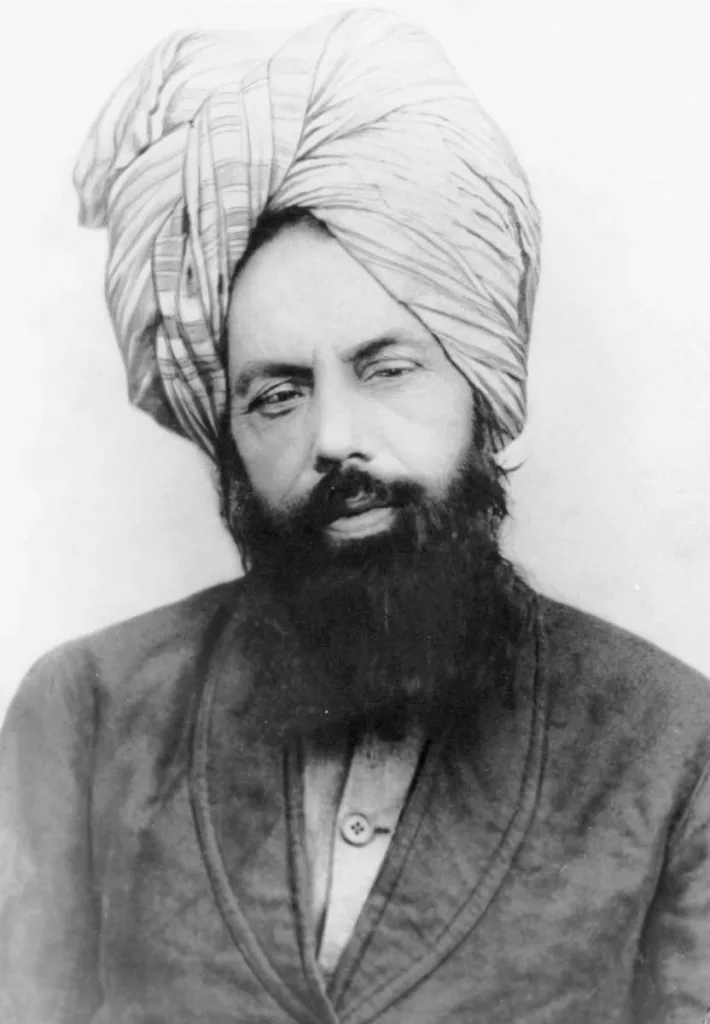
Mirza Ghulam Ahmad, peace be upon him, the Promised Messiah and Founder of the Ahmadiyya Muslim Community
Islamic Prayer – a Most Effective Form of Worship
Earlier we discussed the varying forms of Christian worship, and how they have been a cause for self-secularisation of the Christian faith. But what about Islamic worship. How does that differ?
In stark contrast to Christian worship, the Muslim approach to worship differs significantly. As opposed to gathering once a week, Muslims are obligated to worship at the mosque five times a day. And if they cannot, they are still obligated to pray five times a day, at prescribed times. Typically, they will worship at home, at the workplace, or even while travelling, if they cannot do so at the mosque.
Furthermore, as opposed to merely sitting and listening to the service, Muslims engage in a series of prescribed postures, which include standing, bowing, sitting, and prostrating, each of which are accompanied by a corresponding prayer. These postures have deep psychological consequences.
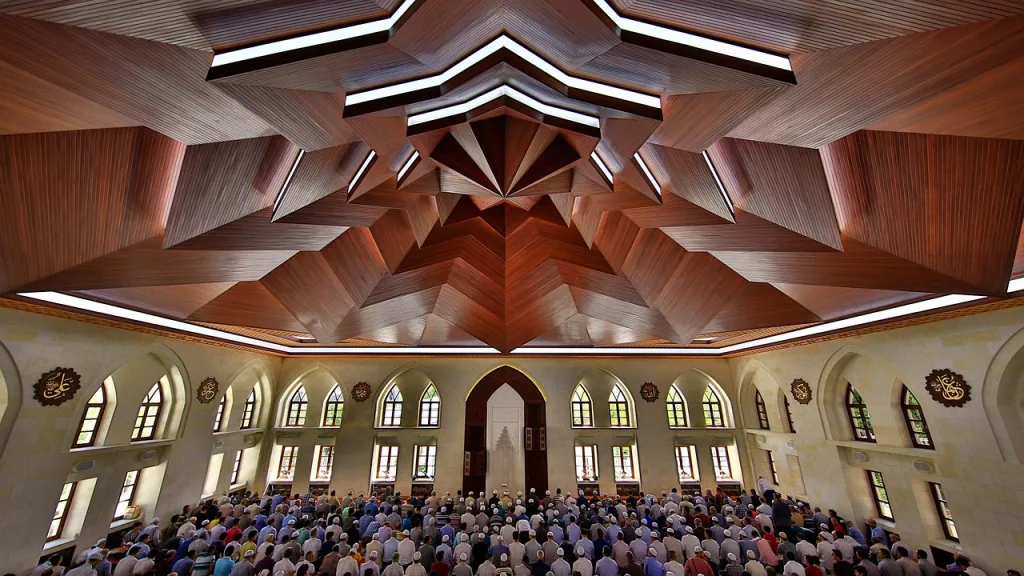
The postures in prayer are physical expressions of our emotions. They help generate deeper sentiments than what simply words could achieve. Acknowledging this connection between the body and the soul, Mirza Ghulam Ahmad, the founder of the Ahmadiyya movement, commenting on the significance of prostration in the Islamic mode of worship, states:
“God Almighty has kept a reciprocal connection between the soul and the body, and the body affects the soul. For example, if a person tries to cry as a formality, after all, he does start crying. Similarly, a person who tries to laugh as a formality eventually starts laughing. Similarly, the conditions that come upon the body in Salat [Muslim Prayer], like standing and prostrating, also affect the soul. The extent to which he shows humility in his body is the extent to which it is created in the soul. Although God does not accept prostrations alone, but prostration has a connection with the soul. That is why the last station in Salat is prostration. When a person reaches the furthest station of humility, at that time, all he wants is to go into prostration. This condition is witnessed even in animals. When dogs love their master, they come and place their head on his feet, and they express their connection of love with prostration. From this, we clearly find that the body has a special connection with the soul.”[48]
Secondly, the frequency and regularity in the Muslim mode of worship creates discipline and instils an element of sacrifice. While a Christian only has to attend a Church on a late Sunday morning, a Muslim, by comparison, has to ensure that he rises daily in the middle of the night for worship. Despite the disparities between the two religions, which, from a practical point of view, overwhelmingly favour Christianity, mosques tend to be more populated than churches. Contrasting the two modes of worship, the Second Caliph of the Ahmadiyya movement continues:
“In comparison to [Christian services] the five daily Prayers are prescribed for Muslims. Despite the fact that Christians only have to go to church once a week, whereas Muslims go to the mosque five times a day, mosques are still more populated compared to churches…. If mere worship through the heart was considered enough, Muslims too would have become lazy like the Christians, and in a short time would become completely negligent towards their Prayers, for one can easily lie and say that he remembers God in his heart, whereas a Muslim cannot say such a thing… Hence observe that there will be very few Muslims who never attend a mosque… You will find very few people amongst the Muslims who have not offered a single Prayer for a few years. In contrary to this, you will find hundreds of thousands who have not even seen a church for forty years.”[49]
Christians who no longer attend church services may miss worshipping God. But Muslims, by and large, cannot fathom going a day without engaging in worship. While many Christians turn to God at the end of the week, for Muslims, God is in their minds every day of the week. Quite literally. On account of the regularity and the physical nature of the Muslim prayer, God is never cast aside.
Qur’an and its Harmony with Science
Earlier, we highlighted various claims in the Bible that contradict established science. As illustration, we looked at two established scientific facts: age of the earth and biological evolution, and whether biblical evidence aligns with established science. We review the very same facts, and how they are viewed in the Holy Qur’an.
We mentioned that biblical evidence doesn’t always allow for a symbolic interpretation. If a biblical verse was to be interpretated symbolically, then there must be a biblical justification to do so. We showed that with reference to six days of creation, the bible cannot favour a symbolic interpretation. But what about the Qur’an?
Just like the Hebrew Bible, the Qur’an also refers to six days of creation, using a similar term in Arabic. However, there is no reference to a 24-hour period with a morning or evening. In fact, there is no reference to anything that indicates a 24-hour period. But there are multiple references to the period being thousands of years long, or even hundreds of thousands of years long. In this case, a symbolic interpretation is positively supported, while a literal interpretation is not. We cannot, however, say the same about the Bible.
Similarly, biological evolution is a feature deeply embedded in the text of the Qur’an – including it’s very first chapter, which only comprises of only seven short verses. While the Qur’an rejects Darwinian form of biological evolution, which is driven by random processes, it supports that development of species over lengthy periods of time occurs under the direct command of God:
“And thy Lord creates whatever He pleases and selects. It is not for them to select. Glorified be Allah, and far is He above all that they associate with Him.” (The Holy Qur’an, 28:69)
Thus, not surprisingly, we witness divergent roles the two scriptures have played within their respective communities. Discoveries in modern science have led many astray, including some of the most eminent scientists of this age. However, the same could not be said of Muslims. At the height of their dominion, scientific discoveries never played a major role in drawing the believers away from religion.
Biological evolution is a test case. This may appear as surprising to many, but as a scientific theory, it has its beginnings – not in the 19th century voyages of Charles Darwin – but in the minds of Muslim thinkers from centuries earlier, such as the great Arab historiographer, Ibn Khaldun. Not one hinged from their faith. Rather, their discoveries found support in the Qur’an. And Islam continued to flourish despite scientific advancements.
There are many who dispute the integrity of the Qur’an in light of modern science. But history bears the testament of its truth. While Christian scientists did give birth to the Enlightenment, they became a victim of their own progress – eventually contributing to the downfall of Christianity. However, with Islam the story is entirely different at the height of its very own enlightenment – the Islamic Golden Age.
In short, while Christian theologians today find themselves in a quandary, Muslim theologians did not – or, more precisely, could not. Indeed, if a scripture is truly God’s word, it would naturally fall in line with His works. As new discoveries come to the fore, science – rather than becoming a source of trouble – would become a source of its intellectual defence. And this is what we observe in Islamic history.
Conclusion
The religious divide between the Christian West and the Muslim world also doubles as an economic divide. This has led many to suggest that the primary barrier preventing the secularisation of the Muslim world is its lack of economic prosperity.
Contrary to popular opinion, the economic status of any nation is not a predictor of the trajectory of its people with respect to religiosity. When the Christian West entered its period of economic prosperity, it shed its religion. The Muslims, however, did not. Those who suggest otherwise forget that the Muslims have already been through a period of economic prosperity on par with the Christian West. When Europe was mired in the dark ages, the Muslim world was a beacon of light for the entire world.
One may ask, why was this the case? Many appeal to complex processes over many centuries that led Christian nations astray following the Enlightenment. We appeal to a different cause. We claimed that the underlying theology was the primary driver of the secularisation process. And, similarly, it is also why Muslim nations did not go astray following the Islamic Golden Age. At least not in any way comparable.
In this article we have highlighted several notable differences between the two faiths – some of which are peculiar to Christianity and have contributed to its secularisation in modern times. But perhaps what distinguishes Islam from Christianity, and indeed from all religions of the world – more than anything else – and what gives Islam its life, is its belief in the continuation of divine revelation.

Islam is the only religion that presents living signs of its truth. It does not simply rely on the stories of old. Rather, it points to the present, and demonstrates to the world through the lives of its righteous servants, signs of the existence of God. Islam, unlike Christianity, is the living embodiment of the biblical narrative. Mirza Ghulam Ahmad, peace be upon him, writes:
“Dead is the religion which possesses only past tales and dead is the religion for which the path to Divine recognition has been closed. But Islam is a living religion. The Holy Quran, in Surah Al-Fatihah, declares Muslims to be the heirs to the excellences of all past Prophets, and it teaches them to pray for all the bounties that were given to them. Those who possess only tales of the past cannot be the heirs to these bounties.”[50]
He further writes:
“…any religion that cannot claim fresh revelation accompanied by living signs may be likened to decaying bones that have more or less turned to dust. It is absolutely impossible for such a religion to bring about any real transformation.”[51]
Indeed, what transformation can Christianity bring when it is itself being transformed?
References:
[1] Church of England to consider use of gender-neutral terms for God, The Guardian, 7th February 2023
[2] Calls to refer to God as a woman as female bishops take up posts, The Telegraph, 31st May 2015
[3] Paul Silas Peterson (Editor), The Decline of Established Christianity in the Western World, 2018, Page 60
[4] Ken Ham & Britt Beemer, Already Gone, 2009, Page 39
[5] Ken Ham & Britt Beemer, Already Gone, 2009, Page 41
[6] Ken Ham & Britt Beemer, Already Gone, 2009, Page 151
[7] Why America’s ‘nones’ left religion behind, Pew Research Centre, 24th August 2016
[8] Ken Ham & Britt Beemer, Already Gone, 2009, Page 80
[9] https://www.theguardian.com/world/2014/oct/28/pope-says-evolution-and-creation-both-right
[10] https://churchlifejournal.nd.edu/articles/the-catholic-church-has-never-had-a-quarrel-with-the-idea-of-evolution/
[11] https://www.pewresearch.org/religion/2009/02/04/religious-groups-views-on-evolution/
[12]Evangelicals, evolution, and inerrancy: a comparative study of congregational boundary work, Page 213 https://discovery.ucl.ac.uk/id/eprint/10101658/7/Unsworth_13537903.2021.pdf
[13] https://evangelicalfocus.com/europe/14005/UK-Over-2000-churches-closed-in-the-last-10-years
[14] https://research.lifeway.com/2021/05/25/protestant-church-closures-outpace-openings-in-u-s/
[16] Ken Ham & Britt Beemer, Already Gone, 2009, Page 110
[17] Greg Hawkins & Cally Parkinson, Reveal: Where Are You? 2007, Page 35-36
[18] Church Growth Through Music? Published in LinkedIn, 8th July 2015
[19] Why America’s ‘nones’ left religion behind, Pew Research Centre, 24th August 2016
[20] Leviticus 18:22; 1 Corinthians 6:9; 1 Timothy 1:10
[21] Leviticus 20:13
[22] Matthew 5:32
[23] Marriage after divorce, Church of England
[24] 1 Timothy 2:12 (NIV); 1 Corinthians 14:34-35 (NIV); Ephesians 5:22-24 (NIV)
[25] Celebrations mark 25 years of women’s ordination to the priesthood, Church of England
[26] Liberal cardinal calls for revised Catholic teachings on gays, Reuters, 3rd February 2022
[27] Cardinals press Pope Francis to clarify divorce-remarriage stand, America – The Jesuit Review, 21st June 2017
[28] Paul Silas Peterson (Editor), The Decline of Established Christianity in the Western World, 2018, Page 59-60
[29] Paul Silas Peterson (Editor), The Decline of Established Christianity in the Western World, 2018, Page 99-115
[30] Ken Ham & Britt Beemer, Already Gone, 2009, Page 49
[31] Ken Ham & Britt Beemer, Already Gone, 2009, Page 80
[32] Ken Ham & Britt Beemer, Already Gone, 2009, Page 106
[33] https://rationalreligion.co.uk/bible-vs-quran-on-science-how-old-is-the-universe/
[34] https://rationalreligion.co.uk/evolution-bible-vs-quran-what-does-scripture-say/
[35] Ken Ham & Britt Beemer, Already Gone, 2009, Page 151
[36] R.A. Torrey, Evidence for the Resurrection, 2017, Page 1
[37] 1 Corinthians 15: 13-14 (NIV)
[38] Eyewitnesses of the Resurrection, Evidence Unseen
[39] https://rationalreligion.co.uk/the-intelligent-design-of-jesus-survival/
[40] 13 People Who Survived Things That Sound Pretty Freaking Unsurvivable, BuzzFeed, Mary Colussi
[41] Romans 10:9-10 (NIV)
[42] Galatians 3:10 (NIV)
[43] Galatians 2:15 (NIV)
[44] Ken Ham & Britt Beemer, Already Gone, 2009, Page 80
[45] Ken Ham & Britt Beemer, Already Gone, 2009, Page 61
[46] Mirza Bashir-ud-Din Mahmood Ahmad, Beacon for the Youth, Volume 1, Page 429-430
[47] Mirza Ghulam Ahmad, The Philosophy of the Teachings of Islam, Page 123
[48] Mirza Ghulam Ahmad, Mafuzat, Volume 4, Page 421-422 [Urdu]
[49] Mirza Bashir-ud-Din Mahmood Ahmad, Beacon for the Youth, Volume 1, Page 430-431
[50] Mirza Ghulam Ahmad, Fountain of Christianity, Page 62
[51] Mirza Ghulam Ahmad, The Honour of Prophets, Page 45